
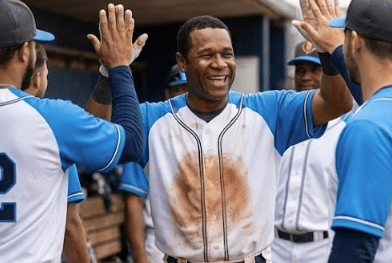
Fifteen years ago, the Biscuits took a flyer on a shortstop in the 4th round. He became the greatest player in franchise history. Now, at 37, Justin Laines is fighting time, gravity, and an oblique strain to finish what he started.
By Elias Thorne | May 15, 2040
There is a specific sound that echoes through the concrete concourses of the Biscuit Basket when Justin Laines steps into the on-deck circle. It isn’t a cheer, exactly. It is more like a collective exhale. It is the sound of 35,000 people realizing that, for the next ninety seconds, everything is going to be under control.
They call him “Rock.” It’s a nickname that fits him so perfectly it feels less like a moniker and more like a geological classification. He is 6-foot-2, 200 pounds of granite and calm. He doesn’t jitter in the box. He doesn’t adjust his batting gloves forty times like Nomar or waggle the bat like Sheffield. He just stands there, switch-hitting from whichever side the situation demands, and waits for the pitcher to make a mistake.
And for fifteen years—from the inaugural spark of 2025 to the gray-bearded grind of 2040—pitchers have made mistakes, and Justin Laines has not missed them.
But today, the Rock is cracked. A strained oblique has him shelved for weeks, an injury that feels rude and intrusive for a man who has defined durability. Laines is 37 years old now. He is making $12.8 million this season to be the spiritual leader of a team chasing the Alpine Warcats. And as he sits on the bench, watching the game he used to dictate, we are forced to ask the question that no Biscuits fan wants to answer: How much time is left?
The Mansura Heat
To understand the player, you have to understand the place. Justin Laines didn’t come up through the glitzy travel ball academies of Florida or the high-velocity pitching factories of Southern California. He came from Mansura, Louisiana—the self-proclaimed “Cochon de Lait Capital of the World.”
Mansura is a town of maybe 1,500 people in Avoyelles Parish, a place where the heat doesn’t just sit on you; it owns you. It’s a heavy, wet heat that slows the pulse and forces you to move with economy. You don’t waste energy in Mansura. You don’t run around shouting and celebrating. You do your work, and you wipe your brow.
Locals tell stories of a teenage Laines taking batting practice on a field that was more dirt than grass, hitting baseballs until the sun dipped below the treeline. He wasn’t flashy. He didn’t have the blinding speed that usually catches a scout’s eye in the deep south. He just hit lines. Hard, flat lines that cut through the humidity like a machete.
“He was quiet,” his high school coach, old man Thibodeaux, once told the Avoyelles Journal. “Scouts would come through looking for the next big thing, looking for 95 miles an hour or a 6.2 sixty-yard dash. Justin was just… consistent. He never swung at a bad pitch. He never bobbled a grounder. He was boring, if you didn’t know what you were looking at.”
That “boring” consistency was his armor. While other prospects were posting highlight reels on social media, Laines was in Mansura, learning to switch-hit because his father told him it was the only way to make sure he played every day. He wasn’t building a brand. He was building a foundation.
The 188th Pick
It is easy to forget now, with the 54.4 WAR and the 310 home runs and the three Championship rings, but Justin Laines was not supposed to be this. He was not a Chosen One.
Go back to the 2025 Inaugural Draft. The scouts liked him, but they didn’t love him. They saw a kid from Mansura with good hands but questionable range. They saw a switch-hitter with “decent” power potential. They saw the quiet demeanor and mistook it for a lack of fire.
He fell. And he fell. And he fell.
Round 1 passed. Round 2 passed. Round 3 passed. Finally, in Round 4, with the 188th overall pick, the Glenira Biscuits selected Justin Laines. It might be the single greatest transaction in the history of the franchise.
He didn’t wait long to prove them wrong. By 2026, his sophomore season, he was already the Platinum Stick Award winner at shortstop. By 2028, he was an MVP candidate. In 2029, he posted what remains the single greatest offensive season by a shortstop in league history: a 1.020 OPS, 33 home runs, and 112 RBI.

The Peak: 2028-2031
If you want to understand why Laines is a first-ballot Hall of Famer, you have to look at the four-year stretch from 2028 to 2031. In modern sabermetrics, we talk about “peak value”—how high was the mountain?
Laines’ mountain was Everest.
- 2028: .312 AVG, 36 HR, 107 RBI (169 OPS+)
- 2029: .308 AVG, 33 HR, 112 RBI (168 OPS+)
- 2030: .364 OBP, 28 HR, 4.1 WAR
- 2031: .367 OBP, 29 HR, 3.9 WAR
He was a machine. He played 150 games a year. He took his walks (over 100 walks in ’26, ’28, ’30, and ’36). He played a premium defensive position while putting up numbers that would make a first baseman blush.
And he was clutch. The game logs are littered with his heroics. The walk-off Grand Slam against the Larsen Swordsmen in 2039. The walk-off double versus the Hercules Tasmanian Devils in 2031. The walk-off RBI single against Alpine—the very team we are chasing today—back in 2030.
Leaderboard Appearances
While the counting stats are impressive, it’s Laines’ dominance relative to his peers that truly stands out. He wasn’t just good; he was consistently at the top of the league leaderboards in nearly every offensive category.
- Total Bases: Led the league twice (2028, 2029) and finished in the top 10 five times.
- RBI: Led the league in 2029 (112 RBI) and finished in the top 10 four times.
- Extra-Base Hits: Finished 2nd in the league four times (2028, 2029, 2030, 2031) – a testament to his gap-to-gap power.
- Runs Created: Led the league three times (2028, 2030, 2031). This advanced metric perhaps best captures his overall offensive value.
- WAR: Led the league in WAR in 2028 (6.5) and finished in the top 10 five times.
His 2028 season was particularly absurd: 1st in WAR, 1st in Runs Created, 1st in RC/27, 1st in wOBA, and 1st in OPS. He was simply the best player in the league.
The Hall of Fame Case
Let’s look at the metrics, because in 2040, we don’t just rely on memories. We rely on the data.
JAWS: 45.1 Black Ink: 4 Gray Ink: 77 HOF Monitor: 112 Career WAR: 54.4
Those numbers paint a picture of a player who was dominant at his peak and sustained his excellence for a decade and a half. A 137 OPS+ for a career is elite territory for a shortstop. For context, Derek Jeter had a career OPS+ of 115. Cal Ripken Jr. was at 112. Justin Laines has spent his entire career hitting 37% better than the league average while playing the toughest position on the diamond.
The Twilight
Now, we are in 2040. The salary has dropped from the astronomical $45 million figures of the mid-30s down to $12.8 million. The knees are creakier. The range at short isn’t what it was in 2026. And now, the oblique strain.
There are whispers that this might be it. That the Biscuits might look to move on, or that Laines might hang them up. But you don’t bet against the Rock.
He has played 1,909 games in a Biscuits uniform. He has 1,910 hits—an incredible symmetry that he will surely break as soon as he comes off the IL. He needs 90 hits to join the 2,000 club. He needs a strong finish to help Glenira catch the Warcats.
When he returns in a few weeks, don’t look at the batting average. Don’t look at the sprint speed. Just look at the hands. Look at the way he stands in the box, unbothered, unhurried, waiting for his pitch.
He is the first Biscuit. And until he says otherwise, he is still the best.

 THE MORNING BISCUIT
Leave a comment